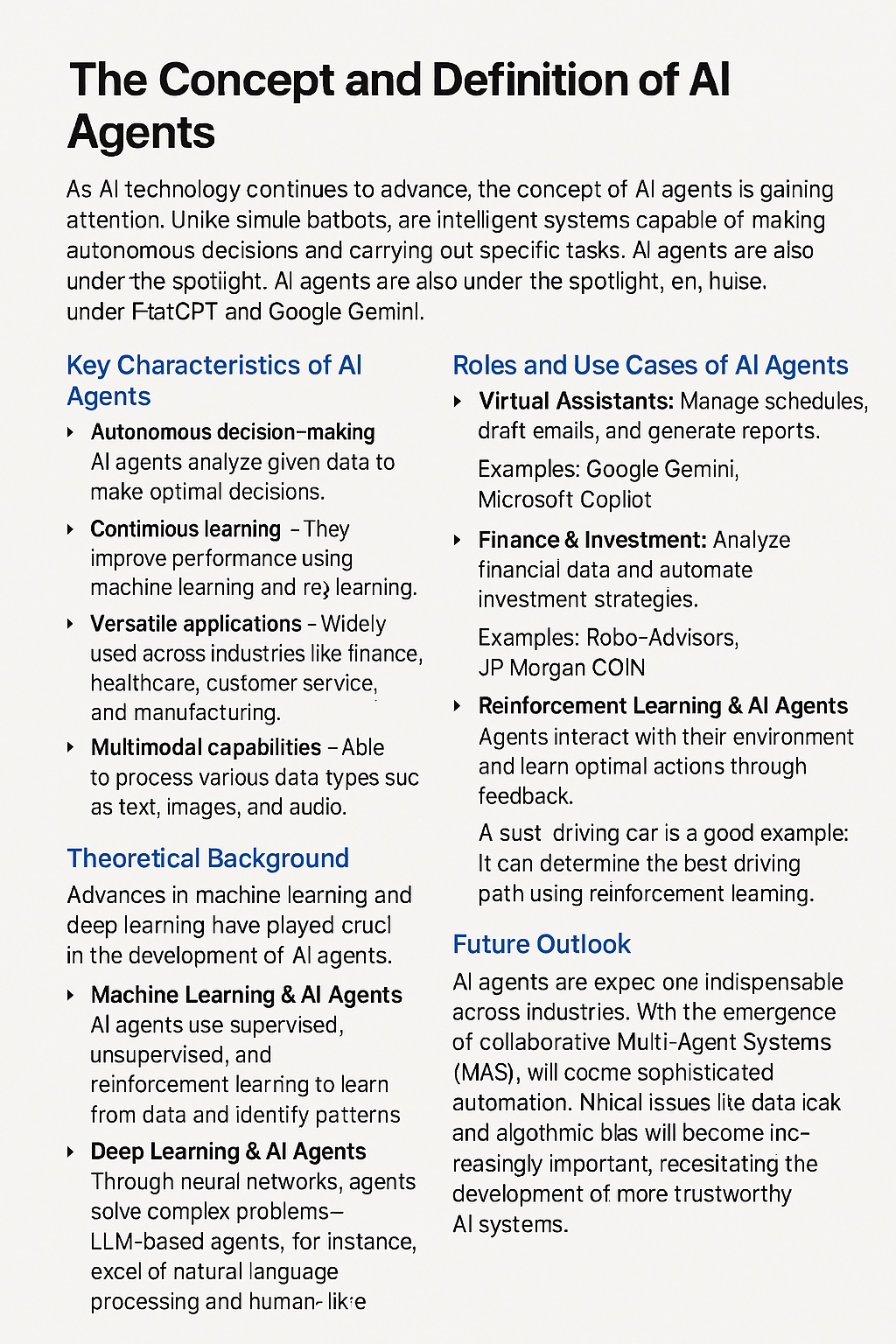
The Concept and Definition of AI Agents As AI technology continues to advance, the concept of AI Agents is gaining attention. Unlike simple chatbots, AI agents are intelligent systems capable of making autonomous decisions and carrying out specific tasks. With the rising popularity of large language model (LLM)-based chatbots such as ChatGPT and Google Gemini, AI agents are also under the spotlight.
Key Characteristics of AI Agents
- Autonomous decision-making – AI agents analyze given data to make optimal decisions.
- Continuous learning – They improve performance using machine learning and deep learning.
- Versatile applications – Widely used across industries like finance, healthcare, customer service, and manufacturing.
- Multimodal capabilities – Able to process various data types such as text, images, and audio.
Theoretical Background Advances in machine learning and deep learning have played a crucial role in the development of AI agents.
- Machine Learning & AI Agents AI agents use supervised, unsupervised, and reinforcement learning to learn from data and identify patterns.
- Deep Learning & AI Agents Through neural networks, agents solve complex problems—LLM-based agents, for instance, excel at natural language processing and human-like conversation.
- Reinforcement Learning & AI Agents Agents interact with their environment and learn optimal actions through feedback. A self-driving car is a good example: it can determine the best driving path using reinforcement learning.
Roles and Use Cases of AI Agents
- Virtual Assistants: Manage schedules, draft emails, and generate reports.
- Examples: Google Gemini, Microsoft Copilot
- Finance & Investment: Analyze financial data and automate investment strategies.
- Examples: Robo-Advisors, JP Morgan COiN
- Healthcare & Medicine: Assist in consultations, diagnostics, and drug discovery.
- Examples: IBM Watson Health, Ada Health
- E-commerce & Marketing Automation: Recommend products and optimize marketing based on user data.
- Examples: Amazon Rufus, Persado
Future Outlook AI agents are expected to become indispensable across industries. With the emergence of collaborative Multi-Agent Systems (MAS), more sophisticated automation will become possible. However, ethical issues like data privacy and algorithmic bias will become increasingly important, requiring the development of more trustworthy AI systems.